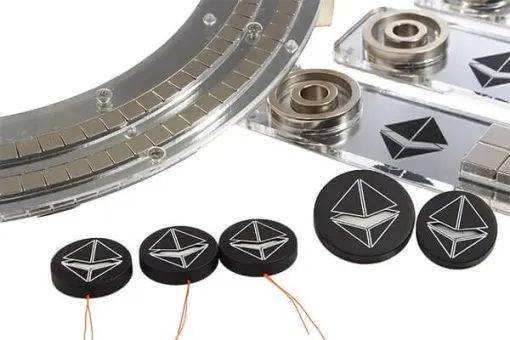
A superconductor is a material that conducts electricity with exactly zero resistance below a certain temperature, and pushes magnetic fields out of its interior while it does so. Both halves of that sentence matter: zero resistance alone would not produce levitation, and the magnetic behaviour is what makes the effect visible on a table.
Zero resistance means zero, not very little
In an ordinary conductor, electrons scatter off vibrating atoms and impurities, and that scattering is what we measure as resistance. It turns electrical energy into heat, which is why cables warm up and why long transmission lines lose a fraction of what they carry.
Below its critical temperature a superconductor loses this entirely. Not “almost nothing” — nothing measurable. A current started in a superconducting loop keeps circulating with no power source; such currents have been observed to persist for years without detectable decay. That is a different state of matter, not a better metal.
It expels magnetic fields
The second defining property is the Meissner effect: as the material cools through its transition, it actively pushes magnetic field out of its interior, becoming a perfect diamagnet.
This is not simply a consequence of zero resistance. A hypothetical “perfect conductor” would trap whatever field was present when it was cooled. A superconductor expels the field regardless of whether it was already there, and that distinction is what marks superconductivity as its own state rather than an extreme of ordinary conduction.
Three limits, not one
Superconductivity switches off if any of three quantities is pushed too far:
- Critical temperature (Tc) — warm the material past it and the state collapses. YBCO’s is about 92 K, or −181 °C.
- Critical field — a sufficiently strong magnetic field destroys superconductivity even at low temperature.
- Critical current (Ic) — push too much current through and resistance returns. This is the practical ceiling for superconducting magnets and cables.
Type I and Type II
Type I superconductors, mostly pure metals, expel magnetic field completely until the field gets strong enough to destroy the state outright.
Type II superconductors, including every material used for levitation demonstrations, behave differently in between. Above a first threshold the field penetrates in discrete quantised tubes called fluxons while the surrounding material stays superconducting. Those tubes can be trapped by defects in the crystal — the effect known as flux pinning, and the reason a YBCO disc locks in place instead of merely being repelled. The difference between the Meissner effect and flux pinning is worth getting right, because the two are routinely conflated.
How we got here
Heike Kamerlingh Onnes discovered the effect in 1911, cooling mercury with liquid helium and finding its resistance vanish at about 4.2 K. For seventy-five years superconductivity stayed a liquid-helium phenomenon, which kept it firmly inside specialist laboratories.
That changed in 1986, when Bednorz and Müller found superconductivity in a copper-oxide ceramic at a far higher temperature, work that won a Nobel Prize the following year. YBCO followed in 1987 at around 92 K — above the boiling point of liquid nitrogen, and therefore above the line separating an expensive laboratory technique from a classroom demonstration. The rise of high-temperature superconductors tells that story in full.
What is still unresolved
Conventional superconductors are well understood. BCS theory explains them: below Tc, electrons pair up through interactions with the crystal lattice, and those pairs move without scattering.
The copper-oxide superconductors that make these demonstrations possible are not explained by BCS, and after nearly four decades there is still no accepted theory of why they work. It is an unusual situation — a technology in routine use whose underlying mechanism remains an open research question. The mechanism behind superconductivity goes into what is settled and what is not, and room-temperature superconductors covers why claims in this field deserve careful reading.
Watching it happen
Superconductivity is one of the few quantum phenomena visible to the naked eye at ordinary scale. Superconducting levitation explains how the properties above combine to hold a disc in mid-air, and what it takes to run the demonstration yourself.