Superconductor Hoverboard Science Fair Project: Build It and Measure It

A superconductor cooled in liquid nitrogen will hang in mid-air above a magnetic track and glide along it with almost no friction — a real hoverboard, at desk scale. It also makes an unusually strong science fair project, because unlike most levitation demonstrations you can measure it, not just admire it.
What you are actually demonstrating
This is the part most projects get wrong, and getting it right is what separates a good board from an average one.
Two different effects are at work, and they are not the same thing:
- The Meissner effect is the superconductor expelling magnetic field from its interior. On its own it produces repulsion — and repulsion alone is unstable. A magnet floating purely by repulsion slides off sideways almost immediately.
- Flux pinning is what actually holds the disc in place. YBCO is a type-II superconductor, which means magnetic field does not get expelled completely. Instead it threads through the material in thousands of discrete quantised tubes, or vortices, and defects in the ceramic trap those vortices where they are. The disc is effectively pinned to the field pattern it was cooled in.
That distinction is why the disc will hang below a magnet, or sit locked at an angle, and stay there. Pure repulsion cannot do that. If your write-up says “the Meissner effect makes it float”, it is not quite right — and a physics teacher will notice.
Turning a demonstration into an experiment
A levitating disc is a spectacle. A science project needs a question with a measurable answer. The demonstration becomes an experiment the moment you introduce something you can change and something you can measure.
Workable questions, in rough order of difficulty:
- How does levitation height depend on the field strength below the disc? Change the number of magnet layers; measure the gap.
- How long does levitation last, and what determines it? Time from removal of coolant to the disc touching down, against ambient temperature or disc thickness.
- How does track spacing affect how freely the disc moves? Vary the gap between magnet rows; measure how far a single push carries the disc.
- Does the cooling height change the pinning? Cool the disc at 3 mm above the track, then at 10 mm, and compare where it comes to rest. This one surprises people, and it is the most direct evidence of flux pinning there is.
Question 4 is the strongest project of the four, because the result is counter-intuitive and it tests the actual mechanism rather than just the outcome.
What you need
- A YBCO superconductor disc (a “levitator”)
- Neodymium magnets, 10 × 10 × 2 mm
- A steel sheet to build the track on
- Track spacers
- Plastic tongs — never handle a cooled disc with bare fingers
- Liquid nitrogen, roughly half a litre, and a shallow foam tray
- A ruler or calipers, and a phone that can shoot slow motion
Everything except the liquid nitrogen is in the superconductivity kits — the two-minute kit guide will tell you which one fits. Liquid nitrogen has to be sourced locally — the liquid nitrogen guide covers where to buy it and how to handle it safely.
Build 1 — the magnet matrix
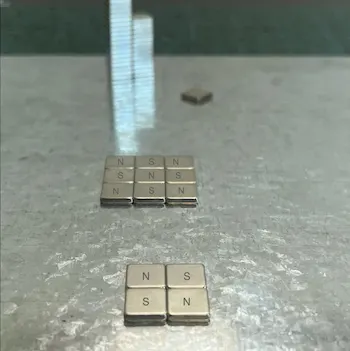
Lay the magnets on the steel sheet in a square — 2 × 2, then 3 × 3, then 4 × 4. Orient them so that neighbours attract side by side, which means adjacent magnets point in opposite directions. This alternating arrangement produces a strong, sharply varying field just above the surface, which is exactly what gives the vortices something to pin to.
Cool the disc in the tray for about a minute, until the vigorous bubbling settles down. Lift it with the tongs and place it a few millimetres above the matrix.
Push it gently sideways, then downwards, then try to rotate it. It resists in every direction — not just upwards. That is the observation worth recording, because it is what rules out simple magnetic repulsion.
Build 2 — the straight track
Rearrange the magnets into two parallel rows: neighbours across the track attract, magnets along the track repel. Push them as close together as they will sit. You want the field to be uniform along the track and strongly varying across it.
Cool the disc, set it on the track, and give it the lightest possible push. It is locked across the track but free along it, so it keeps going until air resistance and small field irregularities stop it. Time how long a single push lasts, and repeat it five times — the spread between runs is itself a result worth reporting.
Build 3 — introduce your variable
Now change one thing at a time and measure. Insert a spacer to widen the gap between the two magnet rows and repeat the timed push. Or cool the disc at two different heights above the same track and mark where it settles in each case.
Take five readings per condition, not one. Superconductor demonstrations vary between runs — how much they vary is a genuine finding, and showing that you know to repeat measurements is worth more to a judge than a single dramatic result.
Observe and think
- Why is the disc stable sideways as well as vertically? What would happen if only the Meissner effect were involved?
- Why does the disc return to the height at which it was cooled, rather than to the closest approach?
- What is actually stopping the disc on a straight track, if there is no contact friction?
- Why does the effect end abruptly rather than fading away gradually?
Safety
Liquid nitrogen boils at −196 °C and causes cold burns on contact. Work in a ventilated room, wear eye protection and insulating gloves, never seal it in a closed container, and have an adult present. The disc stays dangerously cold for a while after it leaves the bath — always move it with tongs. Full guidance and a downloadable risk-assessment template are in the liquid nitrogen guide.
Common mistakes
- Not cooling for long enough. Wait until the bubbling calms. A partly cooled disc will levitate weakly and drop early.
- Magnets all facing the same way. The field then barely varies above the surface and there is little for the vortices to pin to.
- Handling the disc warm-side down. Frost forms quickly; keep the cooled face towards the track.
- Reporting one run. Repeat everything five times and report the spread.
- Calling it anti-gravity. Gravity is unchanged throughout. The disc is held by pinned magnetic flux, and saying so correctly is free marks.
Where to go next
If the project goes well, the natural extension is to measure the transition itself: cool the disc while monitoring its resistance and find the temperature at which it drops to zero. That needs a four-point probe setup and turns a visual demonstration into a quantitative one.
